What would ethics review processes for qualitative, inductive research look like if care were understood as a central guiding principle?
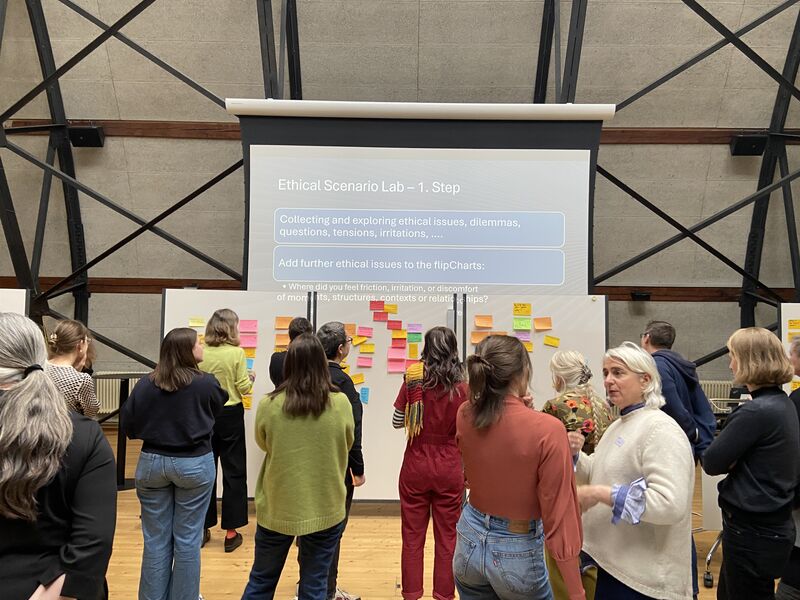
This is the question I have been reflecting on since last week’s two-day event at the Universität Bern, which we organised through @Medical Anthropology Switzerland (MAS) and the @Ethical and Deontological Think Tank (EDTT) together with Karin van Holten, Kurt Vinzenz Zurfluh , @Eva Soom Ammann, @Nolwen Bühler, Anna Mann and Aline Sigrist.
On the first day, we discussed the ethics of health research among researchers, especially in relation to ethnographic and participatory research and questions of participation, observation, and power in practice. Inspiring case examples were presented by Maike Isaac , Isabel Käser , Chantal Britt , Marilena Von Köppen, Séverine Soiron-Ballmer, Katja Jungo and Nora Peduzzi.
On the second day, the exchange between researchers and cantonal and institutional ethics and research commissions took centre stage with @Cornelia Hummel (EK Université de Genève), @Pablo Diaz (EK Université de Lausanne), @Dominique Sprumont (EK VD), Isabelle Wienand (EK Universität Basel and swissethics ) and Heike Geschwindner (EK ZH).
One of the many stimulating inputs I received was a question raised by Settimio Monteverde:
Should we think research and care much more closely together as a fundamental ethical principle? Together, we further elaborated the idea of „caring for research“: Our discussions linked care ethics to questions of attentiveness, responsiveness, solidarity, accountability, credibility, and trust – and to the need to remain sensitive to vulnerability, inequality, and relational complexity in research practice.
These questions feel especially important to me in relation to research involving people living with dementia, legal guardianship, and other vulnerable situations, especially in long-term care. They also resonate more broadly with our work in social work and with reflections on the caring city – that is, on how care can be understood as a guiding principle across institutions, urban life, and everyday social relations.
As the EPICENTRE-PARTICIPATIO team, we repeatedly engage with ethical challenges in research in long-term care. Qualitative research must be able to adapt continuously to the people, situations, and systems it is concerned with. These principles should inform ethical reflection, rather than being blocked by fixed research plans. Otherwise, people may not only risk being harmed, but also being wronged.
Thank you to all organisers, speakers, participants & funders for these inspiring two days.